Content Summary
EducationalBertrand Russell - Theory of Descriptions • Jeffrey Kaplan
TL;DR
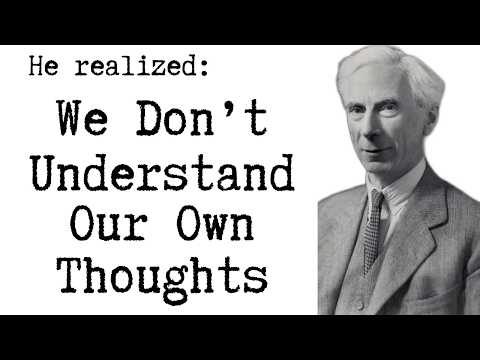
Russell's 1905 "On Denoting" revolutionized philosophy of language by arguing that definite descriptions (phrases starting with "the") don't actually refer to objects as they appear to, but instead make existential claims about what exists in the universe (0:08). This theory reveals that our thoughts have a hidden logical structure fundamentally different from their surface appearance (1:15), suggesting we don't truly understand how our own language and cognition work.
ELI5
Imagine you say "the purple elephant in my room is big." But wait—there's no purple elephant in your room! So how can you say something about it? Russell figured out that when we say "the purple elephant," we're not pointing at a thing like pointing at your teddy bear. Instead, we're really saying "there IS a purple elephant AND there's only ONE AND it's big." Since there isn't one, the whole thing is just... not true! It's like our brain has a secret way of talking that's different from what we think we're saying.
Top Concepts
Keywords
Quick Actions
- !Learn to distinguish between definite descriptions (the X) and indefinite descriptions (a X) in everyday language
- !Apply Russell's three-part analysis when encountering claims about 'the' something
- !Recognize that meaningful sentences about non-existent things don't require those things to exist in any sense
Want to analyze your own content?
Extract insights from YouTube videos, PDFs, and web articles. Free to start.
Try Knowmler Free