Explore Public Analyses
Browse AI-powered analyses shared by the Knowmler community.

Fungi’s Resilience and Intelligence
Show Me the World
Fungi represent a vast, ancient kingdom of organisms whose remarkable abilities — from decomposing toxic waste and producing industrial enzymes to forming symbiotic networks with plants and inspiring resilient network design — offer transformative solutions to modern environmental and technological challenges. The documentary argues that with less than 15% of fungal species identified, we are only beginning to tap into fungi's "unique form of intelligence" that has allowed them to survive every major extinction event and colonize virtually every environment on Earth. Key experts including Paul Stamets (mycoremediation), Guillaume Becquart (mycorrhizal symbiosis), and Mark Fricker (network optimization) demonstrate how fungal systems already provide elegant, self-organizing solutions to soil pollution, desertification, and fragile human infrastructure networks.

Semiconductors explained in 16 mins | Chris Miller
Big Think Clips
Semiconductors are paradoxically among the most difficult things humans manufacture despite being ubiquitous, requiring atomic-level precision, ultra-purified materials, and $20 billion factories — which is why only a handful of companies can produce cutting-edge chips. Moore's Law has driven transistor counts from one-per-hand in the 1950s to 10 billion per fingernail-sized chip today, sustained not by physics but by economics, and this relentless pace of improvement is now fueling a new wave of AI advancement. The global chip supply chain is extraordinarily concentrated and interdependent, with TSMC manufacturing ~90% of advanced processor chips and ASML providing the sole source of extreme ultraviolet lithography tools.

Your SaaS Bill Just Got a Second Meter. You're About to Pay It.
AI News & Strategy Daily | Nate B Jones
The video argues that SaaS vendors like Salesforce, Microsoft, and ServiceNow are introducing a second billing meter alongside traditional seat-based pricing to charge for AI agent actions ("work units," "credits," "governed operations"), fundamentally changing enterprise software economics. Builders and buyers who fail to negotiate agent access terms, understand the new pricing primitives, and ask hard questions before renewal will find their agent economics controlled by vendors who define and meter the work. The core thesis is that the commercial unit of software is shifting from human seats to delegated agent work, and understanding this distinction is critical for cost control and negotiation leverage.
Frontier AI Labs Are Entering The Arena and Other Big HR Tech Stories
Brett Ungashick
Frontier AI labs like Anthropic and OpenAI are no longer content to be model providers — they are actively building software products (including HRIS), launching consulting subsidiaries, and recruiting top enterprise talent, signaling a fundamental shift in HR tech's competitive landscape. Meanwhile, the broader HR tech market is consolidating around managed services, compliance acquisitions, and workforce operations convergence, with major moves from Paylocity, Gusto, TriNet, Deel, and leadership changes at isolved reflecting an industry reshaping itself around AI, simplicity, and operational coverage.
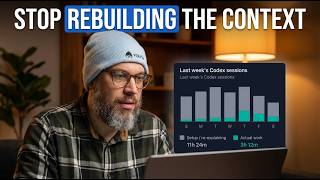
You're Wasting 40% Of Your AI Time On Something Fixable
AI News & Strategy Daily | Nate B Jones
The video argues that most AI users waste enormous time over-relying on prompts when they should be building reusable scaffolding—skills, plugins, MCP connectors, hooks, and scripts—around their LLMs. The presenter provides a clear taxonomy of these components: prompts for one-offs, skills for repeatable processes, plugins as installable workflow packages containing multiple components, MCP connectors for live data access, and scripts/hooks for deterministic checks. The core thesis is that in 2026, non-engineers can and must build this scaffolding themselves because domain experts—not just engineers—understand the workflows that need to be encoded.
Richard Sutton – Father of RL thinks LLMs are a dead end
Dwarkesh Patel
Richard Sutton, the Turing Award-winning father of reinforcement learning, argues that LLMs are fundamentally limited because they learn from human-generated text rather than from direct experience with the world, lack genuine goals, and cannot learn continually. He advocates for an experiential paradigm where agents learn through trial-and-error interaction with their environment—sensing, acting, and receiving rewards—which he believes will ultimately supersede LLMs as another instance of the bitter lesson, where scalable general methods defeat approaches built on human knowledge.
Workday Brings Sana Self-Service Agent for HR and Finance Into Microsoft 365 Copilot
Workday has launched its Sana Self-Service Agent as an integration within Microsoft 365 Copilot, enabling employees and managers to handle routine HR and finance tasks—such as checking time-off balances, viewing payslips, and submitting expenses—directly inside Microsoft 365 without switching applications. The integration couples Sana's agentic AI intelligence with Workday's deterministic business processes to maintain security, compliance, role-based permissions, and auditability while automating everyday workflows. This reflects a broader industry trend toward interoperable, agent-to-agent AI ecosystems that meet employees "in the flow of work."
Management Time: Who's Got the Monkey?
Oncken and Wass argue that managers unknowingly surrender their time by accepting "monkeys" (next-move responsibilities) from subordinates, which reverses the hierarchical relationship and traps managers in a vicious cycle of subordinate-imposed work. The solution is to systematically transfer initiative back to subordinates through structured appointments, clear rules for "feeding" monkeys, and ensuring every problem leaves the manager's office on the subordinate's back. Stephen Covey's commentary updates this 1974 classic by noting that effective delegation now requires trust-based empowerment partnerships rather than simply handing problems back in a dictatorial fashion.
The Work Primitive: What Every AI Product Leader Gets Wrong
AI News & Strategy Daily | Nate B Jones
The video argues that the real strategic battleground in AI is not whether agents can use computers (clicking buttons, browsing, etc.) but whether they understand the semantic meaning of the work they're performing — what the speaker calls "work primitives." AI product leaders are distracted by flashy computer-use demos (0:00) when the durable competitive advantage lies in making work semantically legible to agents through structured, permissioned, reviewable units of work like refunds, approvals, and calendar operations (5:30). The speaker frames this as a platform fight where the winner will be whoever controls the "meaning layer" — not just access — and offers this as a roadmap for startups and enterprise software companies alike (15:00).
66/100The Work Primitive: What Every AI Product Leader Gets Wrong
AI News & Strategy Daily | Nate B Jones
The video argues that AI product leaders are over-focused on agents' ability to use computers (clicking buttons, browsing) when the real competitive moat lies in controlling "semantic work primitives" — making the meaning, permissions, and implications of work actions legible to agents, not just technically accessible. The speaker presents a three-layer framework (access, meaning, authority) and contends that the coming platform fight will be won by whoever defines and owns the semantic meaning of work, using examples from coding agents, Perplexity's strategy, and the Salesforce vs. SAP divergence to illustrate why surface-level computer use is merely a bridge to a deeper, more durable product architecture.
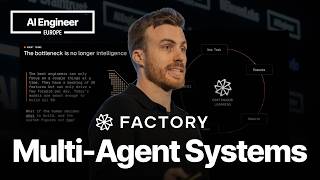
Missions: Multi-Agent Systems That Ship for Days — Luke Alvoeiro, Factory
AI Engineer
Luke Alvoeiro presents "Missions," Factory's multi-agent system that enables software engineering tasks to run autonomously for hours or days by combining delegation, creator-verifier, broadcast, and negotiation patterns into a three-role architecture (orchestrator, workers, validators). The core thesis is that the bottleneck in software engineering is no longer model intelligence but human attention (1:00), and structured multi-agent ecosystems with adversarial validation and serial execution can remove that bottleneck, enabling teams to manage 3x more work streams. The system's longest mission ran 16 days, with validation contracts written before implementation being the key innovation that prevents drift over extended autonomous runs.
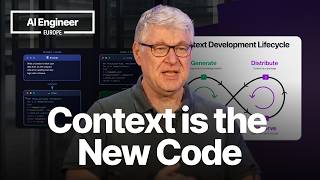
Context Is the New Code — Patrick Debois, Tessl
AI Engineer
Patrick Debois argues that as AI coding agents generate most code, the critical differentiator becomes the context you feed them — prompts, skills, documentation, and organizational knowledge — and proposes a "Context Development Life Cycle" (CDLC) analogous to the Software Development Life Cycle, covering context generation, testing (evals), distribution (packages/registries), observation (agent logs, production feedback), and adaptation. Drawing parallels to his 2009 DevOps movement, he frames LLMs as mere engines that perform only as well as the context "fuel" they receive (14:50), urging teams to engineer context with the same rigor we apply to code — including linting, unit-test-like evals, CI/CD pipelines, dependency management, and security scanning.
Context Engineering vs Harness Engineering vs Software Engineering
Boundary
The panel argues that "harness engineering" — building deterministic orchestration layers around LLMs and RL-ing models to specific tool interfaces — represents the genuinely new and valuable evolution beyond basic context engineering (8:45), while warning that most engineers should exhaust simpler approaches before stacking complexity. The core thesis is that the real skill isn't writing code (which is increasingly cheap) but developing the "philosophy engineering" intuition to know which parts of your system deserve hand-optimization versus delegation to frontier models (17:30), and that locking into rigid architectural patterns too early is dangerous as models evolve unpredictably (23:25).
Recursive Language Models
Alex L. Zhang; Tim Kraska; Omar Khattab
This paper introduces Recursive Language Models (RLMs), a general inference paradigm that treats arbitrarily long prompts as external environment variables rather than feeding them directly into the neural network, enabling LLMs to programmatically examine, decompose, and recursively call themselves over snippets of the prompt. RLMs process inputs up to two orders of magnitude beyond model context windows and dramatically outperform vanilla frontier LLMs and common long-context scaffolds across four diverse tasks while maintaining comparable cost. A small-scale post-trained model (RLM-Qwen3-8B) improves over its base by 28.3% on average, demonstrating that training natively recursive language models is a promising new axis of scale.
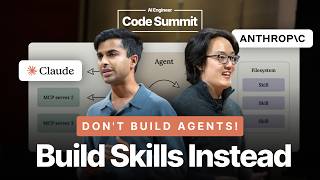
Don't Build Agents, Build Skills Instead – Barry Zhang & Mahesh Murag, Anthropic
AI Engineer
Everything We Got Wrong About Research-Plan-Implement - Dexter Horthy
MLOps.community
Dexter Horthy presents a candid retrospective on the Research-Plan-Implement (RPI) methodology for AI coding agents, admitting key mistakes: they were wrong about not reading code, wrong about relying on long plan files, and wrong about using monolithic prompts. The evolved methodology, now called "CRISPY" (Context, Research, Investigate, Structure, Plan, Yield), splits the original 85-instruction mega-prompt into smaller focused prompts under 40 instructions each, introduces a 200-line design discussion document for human-agent alignment, and emphasizes that engineers must read and own the code they ship. The core thesis is that 2-3x productivity with quality is far better than 10x speed with slop, and the engineer's thinking should never be outsourced to the AI.
 42/100
Which SOPs Should You Document First? The Ones That Make You Money (71% More Revenue)
Pro Sulum
The video presents a "Revenue First SOP Framework" arguing that business owners should prioritize documenting Standard Operating Procedures that directly generate revenue—specifically client onboarding, sales follow-up, and billing/collections—rather than convenient but low-impact operational tasks. The hosts cite data showing law firms with proper billing SOPs saw 71% more revenue and businesses with documented sales processes close 28% more deals, making the case that a "good enough to use" SOP documented in 5 minutes and delegated immediately is far more valuable than a perfect manual that never gets finished (7:42). The conversation ultimately positions Pro Sulum's Virtual Systems Architects (VSAs) as a solution that documents processes while performing them, eliminating the catch-22 of needing time to systematize while being too busy doing the work yourself.
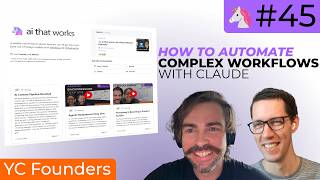
How to Automate Complex Workflows with Claude: 🦄 #45
Boundary
Kevin Gregory demonstrates how he automated the entire production pipeline for the "AI That Works" podcast using Claude Code commands, BAML structured outputs, browser agents, and multi-step email generation. The core thesis is that automation doesn't have to be all-or-nothing — you can automate 90-95% of a workflow while keeping humans in the loop for high-stakes outputs like public posts and email blasts (5:45). The pipeline reduces episode prep from 3-4 hours per week to roughly 10 minutes, covering thumbnail generation, Riverside/Luma event creation, RSS feed updates, clip extraction, and AI-slop-resistant email composition (8:15).
Apple, Acceleration, and AI – Stratechery by Ben Thompson
This Stratechery weekly roundup (Week 14, 2026) centers on Apple's 50th anniversary and its strategic position in the AI era, arguing that Apple's historic strength in hardware-software integration could become a vulnerability if AI shifts the point of integration. The edition also covers the Axios supply chain hack as a case study for AI's dual role in cybersecurity, and Apple's troubled $750 million Formula 1 broadcasting deal.
llm-wiki · GitHub
262588213843476
Andrej Karpathy proposes the "LLM Wiki" pattern — instead of using RAG to re-derive knowledge from raw documents on every query, have an LLM incrementally build and maintain a persistent, interlinked markdown wiki that compounds knowledge over time. The key insight is that LLMs eliminate the maintenance burden that causes humans to abandon wikis, handling all cross-referencing, summarizing, contradiction-flagging, and bookkeeping while the human curates sources and asks good questions. The pattern uses a three-layer architecture (raw sources, LLM-generated wiki, schema/config) with three core operations (ingest, query, lint) and is intentionally abstract so it can be adapted to any domain or tooling preference.
Project Glasswing: Securing critical software for the AI era
Anthropic announces Project Glasswing, a coalition of major tech companies (AWS, Apple, Google, Microsoft, NVIDIA, etc.) formed because their unreleased Claude Mythos Preview model has demonstrated that AI can now surpass most humans at finding and exploiting software vulnerabilities—discovering thousands of zero-day flaws in every major OS and browser, including bugs that survived decades of human review. The initiative commits $100M+ to use these AI capabilities defensively before they proliferate to malicious actors, representing an urgent effort to give cyber defenders an advantage in what Anthropic frames as a fundamental shift in the cybersecurity landscape.
How we made Notion available offline
Raymond Xu
Notion's Offline Mode required evolving their existing best-effort SQLite cache into a persistent storage layer with strong guarantees about data completeness and freshness. The core architectural innovation was a "forest of offline page trees" data model that tracks multiple independent reasons why each page should be available offline, ensuring pages are only removed when all reasons expire. They also implemented push-based syncing with incremental updates to keep offline pages fresh without expensive polling or full rebuilds.
Peritext: A CRDT for Rich-Text Collaboration
Peritext is a novel CRDT (Conflict-free Replicated Data Type) algorithm designed specifically for merging rich-text documents with inline formatting like bold, italic, links, and comments. The paper argues that existing plain-text CRDTs and naive approaches (Markdown, control characters, JSON spans) fail to preserve user intent when merging concurrent formatting changes, and presents a solution using anchor-point-based formatting operations that correctly handle overlapping spans, boundary insertions, and conflicting edits. Peritext enables asynchronous collaboration workflows — similar to Git branching for developers — where writers can work independently on document versions and merge them later while maintaining consistent, deterministic results across all users.

How To Connect Claude to Trading View (Insanely Cool)
Lewis Jackson
The video demonstrates how to connect Claude AI to TradingView via an MCP (Model Context Protocol) tool that allows Claude to read live chart data at the code level rather than through screenshots, enabling real-time interaction with charts, automatic indicator installation, and Pine Script generation directly from natural language commands in the terminal. The presenter shows the full setup process using a simplified "one-shot" prompt, demonstrates creating and applying trading strategies sourced from prominent traders, and introduces his own improvements including a "morning brief" feature that scans an entire watchlist at once and a customizable rules.json file for codifying trading strategies without emotions.
Want to analyze your own content?
Extract insights from YouTube videos, PDFs, and web articles. Free to start.
Try Knowmler Free